
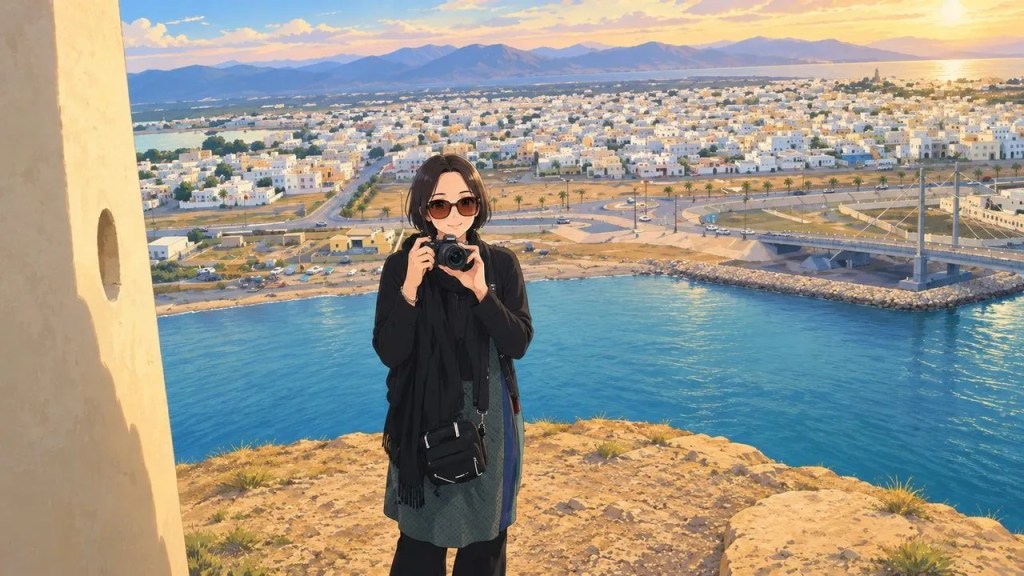
Every morning, when I watch the news, I often feel connected to events happening in places around the world. These places may be far from me now, but I have emotional ties to them through my own experiences and the people I still know and care about who remain there.
Recently, I heard that the US and Israel were preparing to attack Iran, and that one of the most likely consequences would be that Iranian would retaliate against its Gulf neighbours. I imagine that, for most people, news like this conjures up an abstract geography lesson. They see a collection of unfamiliar countries somewhere far away, their names appearing briefly on a television screen before the news moves on to something else.
I used to be that way, too.
Now, I know.
From time to time, people ask me which countries have been my favourites to visit. I always notice a look of surprise and confusion when I tell them that Oman ranks among my top three. I wonder whether they have any idea where Oman is, or why they recognise the country’s name without knowing anything about it. Probably both.
The Sultanate of Oman lies to the southeast of Saudi Arabia, bordering the United Arab Emirates, with Iran just across the Gulf of Oman. They are close neighbours. Very close.
I have swum in those gloriously warm, comforting waters between the two countries, as I imagine people are doing right now, as I write these words. It is difficult to reconcile the peacefulness of those memories with the possibility that the people enjoying the same waters today might soon find themselves living through a very different reality.
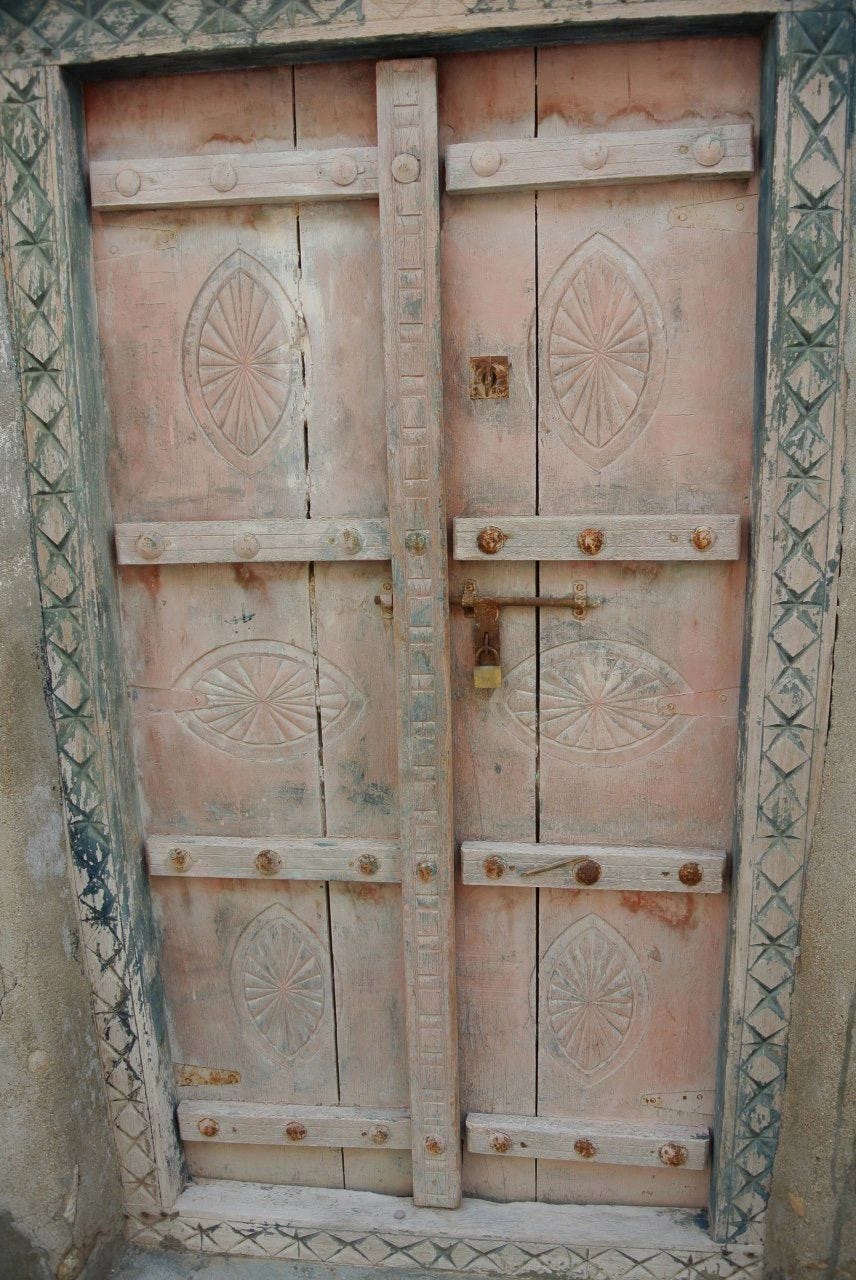
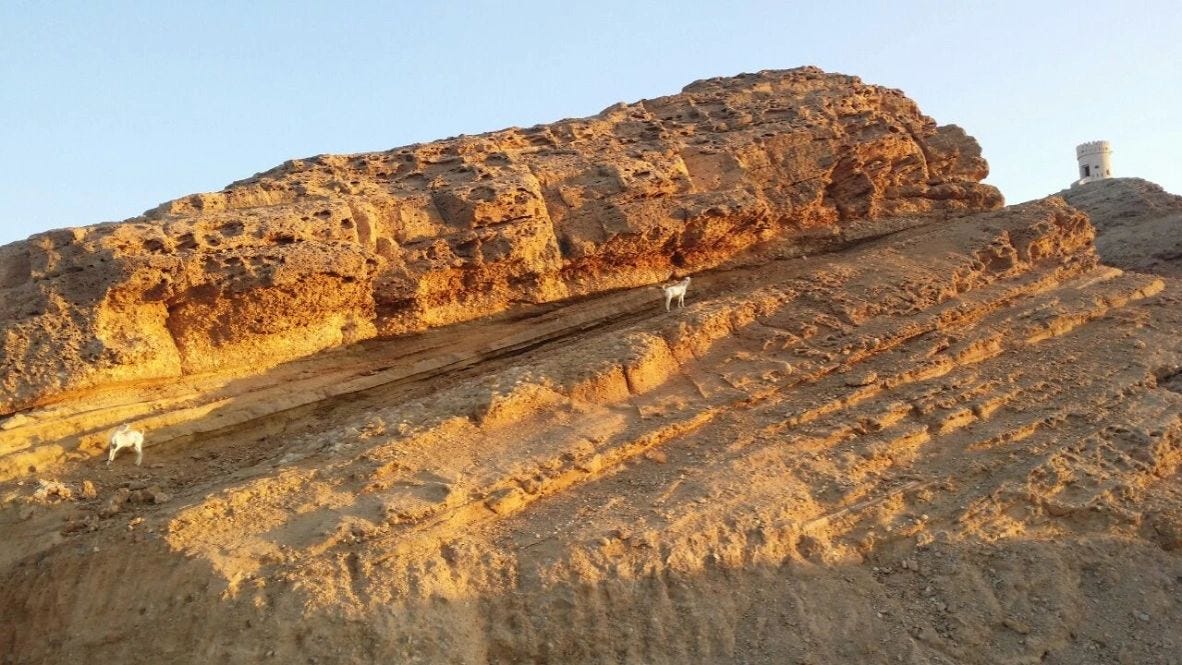
Goats Scamper on an Ancient Seabed
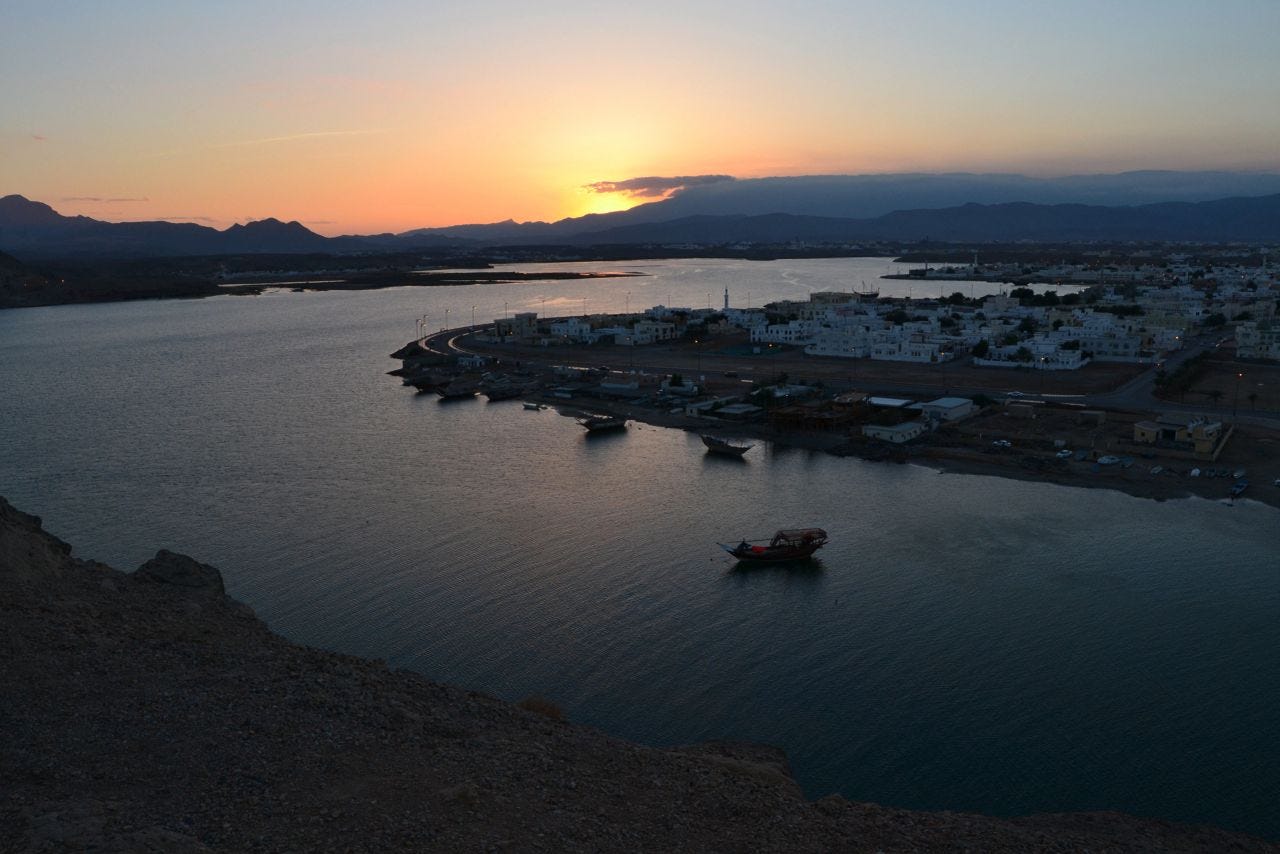
It is early morning in Sur, a small coastal city southeast of Oman’s capital, Muscat. Groups of men are sitting outside the local karak shop, enjoying the sunshine and each other’s company. I can still imagine myself there enjoying the familiar rhythms of an ordinary morning unfolding, sugary sweet karak delivered to my door from the shop downstairs and the day beginning at an unhurried pace.
Sur sits along a coastline that seems to invite you to slow down and breathe.
The journey through the rugged terrain of the Eastern Hajar Mountains is a painful experience if you suffer from motion sickness. The road winds through a landscape of sand-coloured mountains formed from an ancient seabed, twisting around rock faces and seemingly impenetrable terrain. Omani drivers fly through these passages with an apparent disregard for the laws of physics, throwing their passengers from side to side and sending stomachs somersaulting.
My partner was working in Oman for several months, which gave me the opportunity to stay in a serviced apartment on the seafront in Sur for six weeks.
I was in the middle of a very dark period of my life. My last visit to the US had been disastrous, and I was struggling to recover. I had recently lost my job after the university changed its hiring policy and decided not to renew the contracts of lecturers without doctorates. I was severely depressed, without direction, and uncertain about what came next.
In retrospect, my stay in Oman could hardly have come at a better time.
Sometimes, a change of scenery is more than a holiday. Sometimes, it is an opportunity to exist somewhere else for a while, away from the circumstances that have worn you down, and to discover that the world still has things to offer.
Oman certainly did.
We flew to Muscat through Dubai with one of my partner’s colleagues. I am fortunate to be married to a generous man who gave me his seat in business class on Emirates while he travelled in economy with his workmate. Business class was every bit as plush and luxurious as you might imagine, complete with delicious chocolates and biscuits. Unfortunately, I was unconscious for most of the journey.
I arrived in Muscat refreshed, ready for adventure, and carrying a hand luggage bag absolutely crammed with chocolates from Dubai Duty Free.
When I was a child, I had a picture book featuring illustrations of children wearing traditional clothing from different countries. I cannot remember much about the book itself, but one image burned itself into my memory.
It depicted a grand staircase in a fine house, rather like something from a period drama. Children dressed in traditional outfits from around the world mingled on the stairs as though they were attending a debutante ball. At the centre of the landing stood a Caucasian girl wearing a party dress and black Mary Janes. With her stood a little boy dressed in the same outfit as the driver who collected us from the airport in Muscat.
I had carried that childhood image with me for years without really understanding why it had stayed with me. Perhaps it was the variety of clothing, the sense of a world larger than the one I knew, or the idea that children from very different places could occupy the same space, sharing an ordinary moment together.
Whatever the reason, arriving in Oman felt like stepping into a world I had once imagined from the pages of a book.
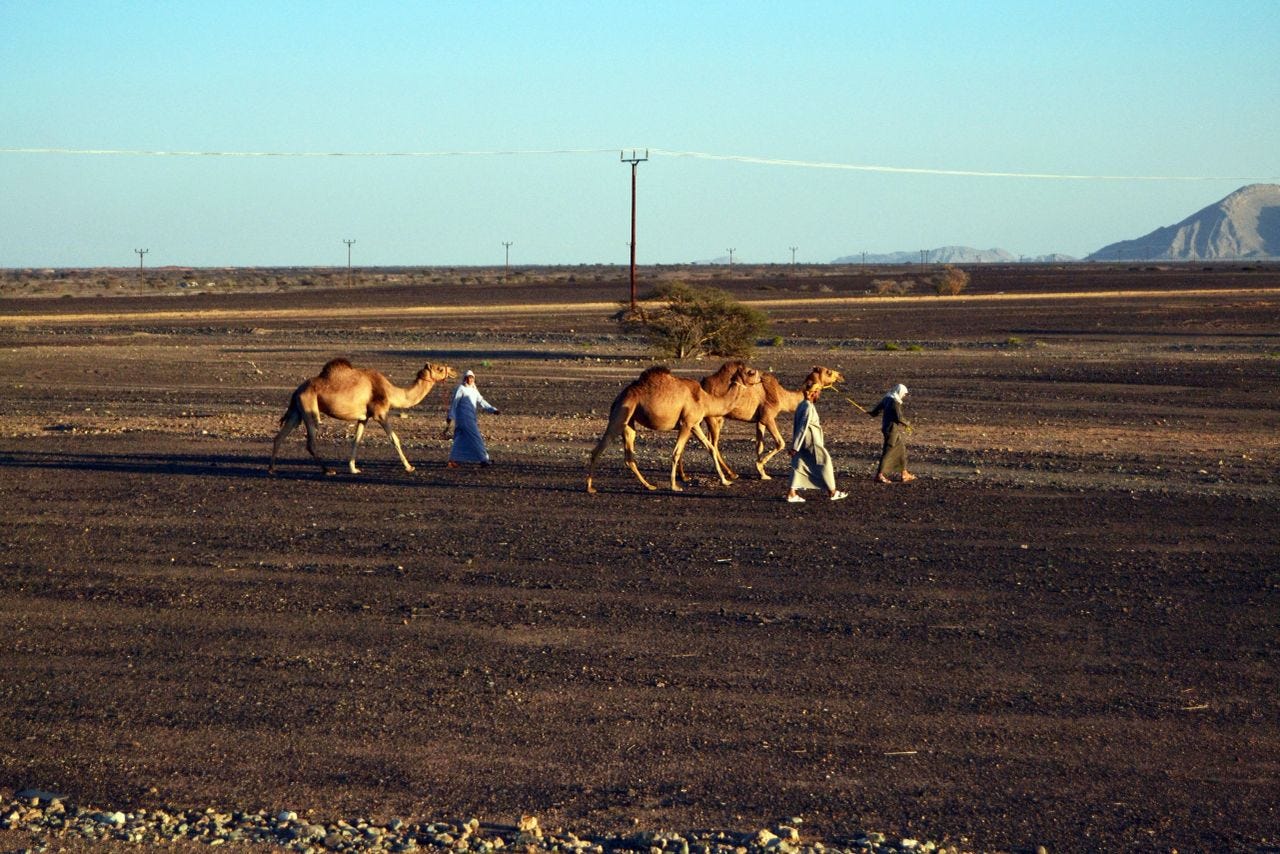
Camel Herders and Pashminas
Omani men wear their heritage as everyday clothing. The combination of a traditional, loose-fitting robe and a beautifully wrapped turban, often in subtle, earthy prints, is both practical in the heat and visually striking against the desert landscape.
There is an elegance to these clothes that I find difficult to describe. They seem perfectly suited to their surroundings, as though the colours and fabrics belong to the landscape itself.
For anyone interested in textiles, Muscat’s traditional waterfront market, Mutrah Souq, is an ideal place to explore. You can find beautiful fabrics at reasonable prices, along with jewellery, souvenirs, and enough fragrant, sugary, highly caffeinated Arabic coffee to keep you buzzing for hours.
You can even buy a camelhair pashmina as soft as a baby’s hair.
I love everything about the colours, the textures, the scents of spices and incense, and the bustle of people moving between the shops in the souq. It is the kind of place where I could happily lose an entire afternoon watching humanity pass by.
One evening, I went downstairs to the karak shop on the ground floor of our accommodation and ordered my one and only Arabic coffee. The group of men who regularly sat at the tables outside invited Donghwan and me to join them.
I accepted.
After drinking the coffee, I proceeded to run up and down the beach across the road like a five-year-old who had just discovered the existence of sugar. I had never experienced such an extraordinary caffeine high. It seemed to last forever.
Eventually, I returned to something resembling a normal walking pace, and Donghwan joined me for a stroll along the seafront.
Darkness settled over the water. Then we heard music.
A man was sitting inside one of the beach gazebos, playing an oud. The instrument’s sweet, distinctive sound drifted out into the night, and he motioned for us to join him. We sat together, listening.
There was no need to fill the silence with conversation. For a while, there was only the music, the darkness, and the three of us sharing the same peaceful moment.
When he finished playing, he told us that he had given up a lucrative career in Dubai to travel around playing his oud.
I was captivated. Here was a man who had walked away from the conventional markers of success to pursue something that gave his life meaning. We had only just met, yet somehow we managed to communicate across our differences in language and experience. Music had provided a common ground that words might never have found.
It was magical.
Then he tried to persuade us to get into his car so that he could take us for a drive.
I almost climbed into the back seat before suddenly realising that we were contemplating getting into a stranger’s car in a foreign country. I panicked. Were we about to be kidnapped?
Sometimes I wonder whether my instincts saved us from danger or whether we missed out on an extraordinary adventure.
I suppose I’ll never know.
The Road to Nowhere
We rented a car so that we could explore the Omani landscape beyond Sur. One sweltering day, we set out for Nizwa, hoping to find a Bedouin market where we could browse silver jewellery, textiles, and handcrafted weapons.
More than anything, I wanted to immerse myself in a heritage so different from my own. I imagined luxurious tents draped in beautiful fabrics, the scent of frankincense drifting through the air, and children riding camels with silver bells dangling from their toes.
I now know that this was ridiculous.
On the way, I had planned a stop at Wadi Ash Shab, one of the region’s spectacular natural attractions, known for its dramatic rocky landscape and pools of water.
I believe we were relying on Google Maps for navigation when I found myself following a mountain road higher and higher into the hills.
The road grew narrower as we climbed, until we were travelling along a precarious track with an unprotected drop beside us. Eventually, I realised that we had reached a point where the road was no longer really a road at all.
It was going nowhere.
Unfortunately, I made this discovery too late to be of any real use.
I consider getting out and pushing the car off the mountain to save us.
There was no convenient place to turn around, and reversing down the mountain seemed considerably more dangerous than attempting a three-point turn. To make matters worse, our rental car had a manual transmission.
I informed Donghwan of my plan without letting on quite how terrifying the situation had become. Somehow, I managed to manoeuvre the car around.
There was a moment when we were facing the cliff’s edge, and our survival appeared to depend entirely on my ability to release the clutch at precisely the right moment.
I have rarely felt so intensely alive.
We survived, obviously, although we never found the wadi.
The experience did, however, provide a useful reminder that trusting Google Maps is not always the same as exercising sound judgement.
In Search of the Bedouin
We continued to Nizwa, still hopeful that we might find the market I had imagined.
Along the way, we stopped at a roadside restaurant and ate lamb chops while sitting on the floor in a private room furnished with ornate cushions and drapery.
At some point, Donghwan chased camels into the desert.
I had to remind him that we needed to be mindful of MERS, the Middle East respiratory syndrome associated with camels.
Eventually, we arrived in Nizwa and headed straight for the market.
No one was there.
In the market sat two elderly men and no one else. We drove out of town feeling thoroughly deflated.
Then a woman drove past us in the opposite direction in a compact car.
She was wearing a battoulah, the traditional Omani face covering worn by some women, particularly among older generations.
It was an unexpected glimpse of a tradition I had hoped to encounter during our travels. And, as so often happened in Oman, the moment reminded me that the most memorable experiences are not necessarily the ones we plan.
Sometimes, they appear when we are lost, when the market is empty, or when the road takes us somewhere we never intended to go.


Leave a Reply