
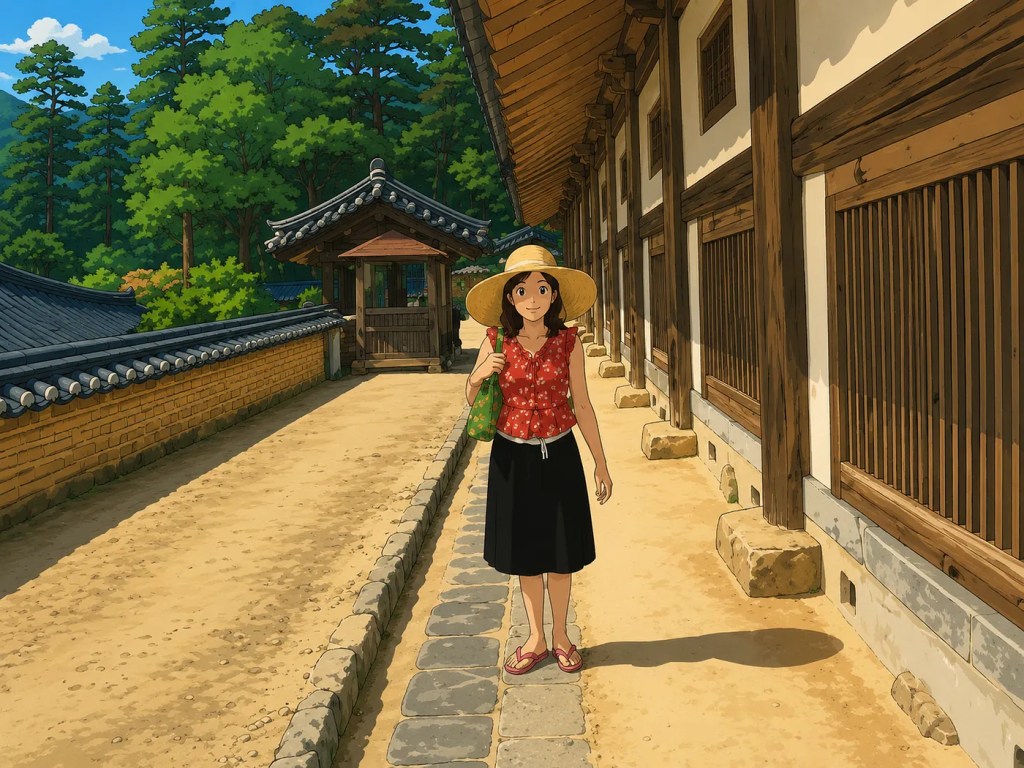
When I first sat down to write this, I hesitated. I wasn’t sure if I wanted to tell this story at all. Most of the people I’ve shared it with have looked at me with disbelief. It seems too strange, too improbable — something that shouldn’t happen. And yet, it did. So I leave it to you to decide whether this story is fact or fiction. For me, it matters because it shattered one of my deepest illusions.
When I first arrived in rural central South Korea, I was housed in a small Buddhist temple in the centre of Geochang, in South Gyeongsang Province. It stood in the oldest part of town, surrounded by narrow lanes and aging buildings, while new apartment complexes were being constructed to accommodate the first wave of foreign English teachers assigned to the region. With nowhere else to put us, our small group was scattered across the town. The women were placed where they could be supervised.
In 2006, this farming community was still deeply rooted in traditional values. Women’s movements were quietly monitored by family and authority figures. A male Korean English teacher from one of the middle schools where I would teach was assigned as my guardian. Because he was Buddhist, I ended up sleeping on the floor of a tiny room inside the temple.
The temple had two floors and one female monk. During the day, the ground floor doors were left open, allowing hot, humid air — and a steady stream of people — to circulate freely. At night, the mosquitoes came. Upstairs, a great golden Buddha sat surrounded by candles, flowers, and offerings of food arranged along an altar that stretched the length of the wall. The aged wooden floor gleamed in the candlelight. Its smooth, wide planks felt warm beneath my bare feet. That room offered brief moments of tranquillity as my world shifted around me.
The shower was nothing more than a concrete stall with icy water. There was no privacy. Each morning began at four o’clock with the sound of the monk striking a gong in the temple garden. In the darkness, members of the community gathered to pray — for health, for success, for their children’s exam results. This ritual repeated itself every day for six weeks.
Meals were vegetarian, prepared by local women, and served three times a day. I sat cross-legged at a low table with the monk, eating in silence. I learned to bathe quickly in cold water and to hide myself away in corners to smoke in secret. Women did not smoke openly, and I quickly lost that small freedom.
Few people in the town had ever seen a foreigner. My presence drew constant attention. Groups of schoolgirls followed me through the streets, giggling, watching, reaching out to touch my eyelashes or run their fingers over the hair on my arms. At first, I told myself this must be what it felt like to be famous. But the novelty wore thin. My nerves frayed under the constant scrutiny.
One afternoon, as I walked back from the main street, an elderly woman burst from behind a blue beaded curtain and rushed toward me, shouting words I couldn’t understand. She wore a hanbok in faded pink, white, and green, the hem dragging along the gravel road. She stopped in front of me, pulled my collar aside, and shoved her hand down my top, feeling the contour of my torso. Then, just as suddenly, she disappeared.
I stood there, stunned.
Later that day, I saw her again in the communal area of the temple grounds.
It was the first time I experienced a profound violation of my dignity in Korea. It would not be the last. From that moment on, I began to build a protective shell — an outward calm that concealed what I felt inside. It is a mask I still wear.
But that was not the illusion that shattered completely. Something more confronting was yet to come.
The temple where I stayed fell under the authority of a larger, more significant temple: Haeinsa, located on Gaya Mountain, 655 meters above sea level. It is home to the Tripitaka Koreana, a vast collection of Buddhist scriptures carved into wooden blocks — something I had studied in university. I was eager to see it for myself.
The monk at my temple had a brother who was also a monk at Haeinsa. She arranged for him to take me sightseeing. By then, I had grown accustomed to having my time managed by others. Consent was rarely asked for; plans were simply made.
He arrived early one morning in a large black luxury sedan — an unexpected sight. But I dismissed the thought. What kind of car should a monk drive, anyway?
We drove into the mountains, stopping occasionally in small villages where he handed out money to children. We shared a simple fried fish meal in silence, unable to speak each other’s language. He sang loudly along to the radio, laughing, while I listened without understanding.
At Haeinsa, we climbed the mountainside to the Janggyeong Panjeon, where the Tripitaka Koreana is housed. Standing there, surrounded by centuries-old scripture, I felt something rare and deeply personal — as though I had been allowed to witness something meant just for me.
After that, he took me on a few more outings: to a traditional sauna, and once hiking up Gaya Mountain with friends. That was the extent of our connection.
Then, one day, I received a text message — a pictograph of a bride and groom. I didn’t understand and didn’t respond.
A few days later, he appeared at the temple with an interpreter and asked me to marry him.
I was stunned. I couldn’t comprehend how he had arrived at this conclusion. We barely knew each other. We couldn’t even communicate without a third person present. When I asked how this would work, he explained that he intended to leave monastic life and teach yoga in Seoul.
I declined.
Days later, an older monk came to inform me that I could not marry him. I assured him I had no intention of doing so.
That was when something shifted in my understanding.
Monks are not abstractions. They are people — ordinary people who have chosen an extraordinary role. Some are deeply committed. Others are not. Some break the rules they are meant to live by and justify it quietly to themselves: Who does it hurt? Who will know?
In some rural parts of Korea, I later learned, this is an open secret.
And just like that, the illusion was gone.


Leave a Reply